Finish comparison • Leather Types
How do aniline and pigmented leather behave differently?
Aniline and pigmented describe different relationships between the hide and its protective finish.
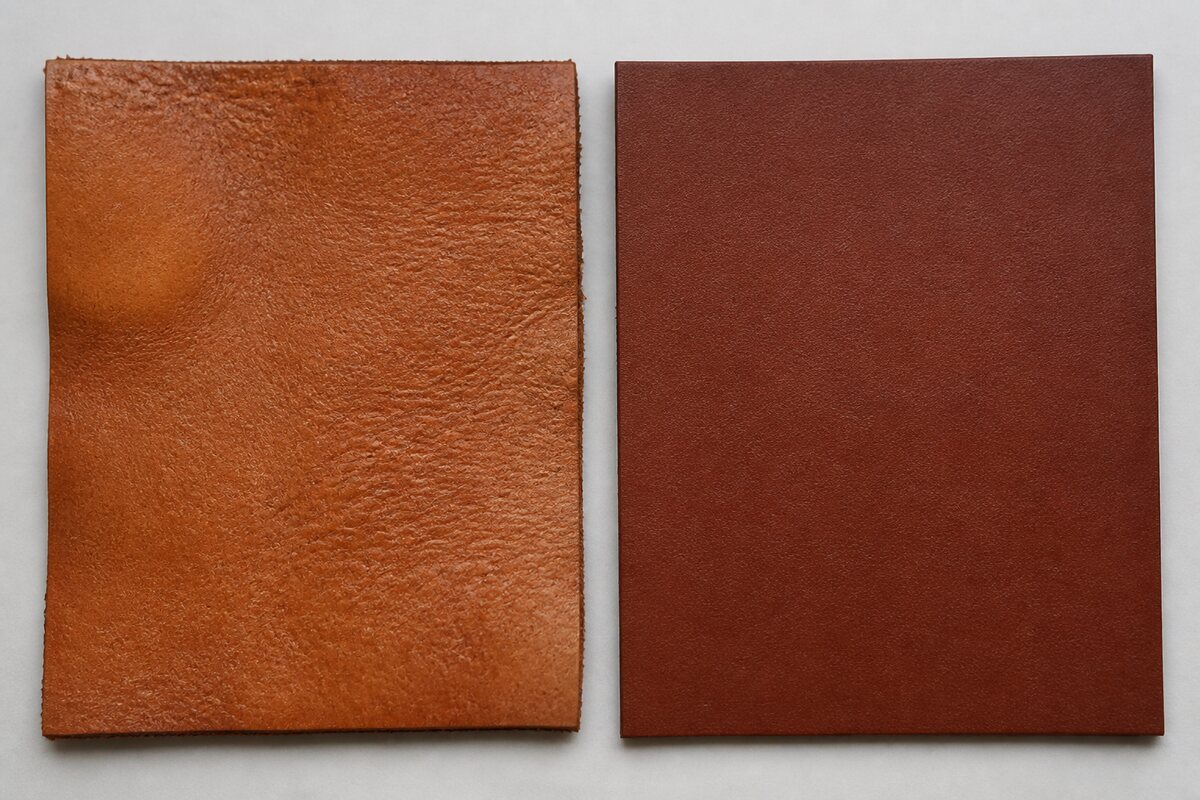
Aniline leather shows more natural surface variation and absorbs liquids more readily. Pigmented leather uses a stronger color and protective layer, which can improve uniformity and everyday resistance.
Neither label is a complete quality ranking. Application, hide, finish quality, use and condition all matter. A visual guess should be marked provisional.
The difference matters because the same cleaner or conditioner can have different consequences.
The distinction lives at the surface
A related working question, treated at length, is leather care household wisdom.
Aniline leather uses transparent color and minimal opaque surface finish, allowing natural grain and variation to remain visible. Pigmented leather carries a more protective color coating that can create greater uniformity and cover natural defects. Semi-aniline uses a light finish between those broad ends. These are finish relationships, not a simple ladder from poor to excellent. Application and workmanship still determine whether a leather is suitable.
A visible pore pattern can support identification, but embossing can reproduce grain and wear can change the original appearance. Color uniformity, absorption, edge structure, sheltered areas and supplier information should be read together. Treat any conclusion from one photograph as provisional. The Leather Types index keeps terminology tied to behavior rather than using it as a prestige label.
Expect different liquid response
A protected pigmented finish often holds a small spill at the surface long enough for controlled blotting, provided the coating is intact. An open aniline surface can darken as liquid enters and can display tide lines or uneven change. That does not justify a casual water-drop test on a visible area. Use product documentation, hidden intact areas and professional identification when the consequence of a mark is high.
Previous wear can reverse expectations. A pigmented surface with coating loss may absorb through an exposed patch, while an aniline leather may carry waxes or a transparent finish that changes its response. Inspect the exact problem area and a sheltered comparison. The spill response therefore asks for both substance and finish rather than offering one universal method.
Read patina and damage with different standards
Aniline leather may develop color variation and a use patina that owners value. That variation is not automatically soil or failure. Pigmented leather can show abrasion as a sharper contrast when the surface color wears. In either case, open cuts, weakened seams and transferable finish remain damage questions. The desired appearance should respect the material instead of forcing every surface toward uniform gloss.
Compare broad changes with local failures. A darker arm and lighter window side can be a history of touch and light; a short line that opens under flex is a repair issue. Use the Diagnostic Atlas to separate material, finish, application and symptom. The structured record prevents a material name from becoming a treatment instruction.
Buy and care with the full specification
When buying furniture or trim, ask for finish type, intended use, care guidance, light exposure limits and repair support. A family home, hotel lobby and preserved show car make different demands. Pigmented leather may offer practical protection; aniline may offer tactile and visual variation. Neither choice is responsible without the use context.
Keep labels and supplier care documents with the item. Test only compatible products, record changes and stop when color, feel or sheen moves unexpectedly. If the surface identity remains uncertain, choose observation and reduced exposure over an aggressive treatment. Material literacy is valuable precisely because it leaves room for uncertainty.
Source note: Leather Naturally. Accessed August 25, 2026.