Regulatory context • Guides & News
Why is upholstery fire safety jurisdiction-specific?
Upholstery fire safety depends on jurisdiction, furniture type, use and the rules in force at the time.
UK government policy documents discuss domestic upholstered furniture and the distinct challenges of reupholstery and repair. That does not turn a policy paper into universal advice for every country.
Keep the regulator, date and product scope visible. Ask a local compliance professional when a project is commercial, public or subject to a labelled standard.
The editorial job is to frame the question accurately, not to issue a certificate.
Start with market, product and supply action
For the fuller treatment of that point, see practical guide.
Fire-safety obligations attach to a jurisdiction, a defined product and an action such as manufacturing, importing, selling, supplying or re-upholstering. A domestic chair placed on the UK market is not the same case as a chair kept by its owner, contract seating in a public venue or furniture supplied in another country. Name those facts before looking for a test, label or material rule.
This page uses current UK statutory guidance as a worked example, checked on August 25, 2026. It is not a universal rule set. The Furniture and Furnishings (Fire) (Safety) Regulations 1988 remain part of the UK framework and were amended in 2025. Anyone making a real supply decision should check the latest official guidance and obtain qualified local advice for the exact product.
Separate changes already in force from wider reform
The 2025 amendment came into force on October 30, 2025. Official guidance says it removed specified baby and young children's products from the 1988 regime, removed the display-label requirement and extended the period for authorities to begin proceedings from six to twelve months. It did not make every other furniture obligation disappear. In particular, the guidance distinguishes the removed display label from the permanent label.
The government has also continued a wider reform process, including a 2026 consultation. A consultation describes proposals, not law already in force. Keep the publication date, status and implementation date beside every regulatory statement. If a page cannot distinguish enacted amendment, statutory guidance, policy paper and open proposal, it should not be used as a compliance checklist.
Document before opening an upholstered item
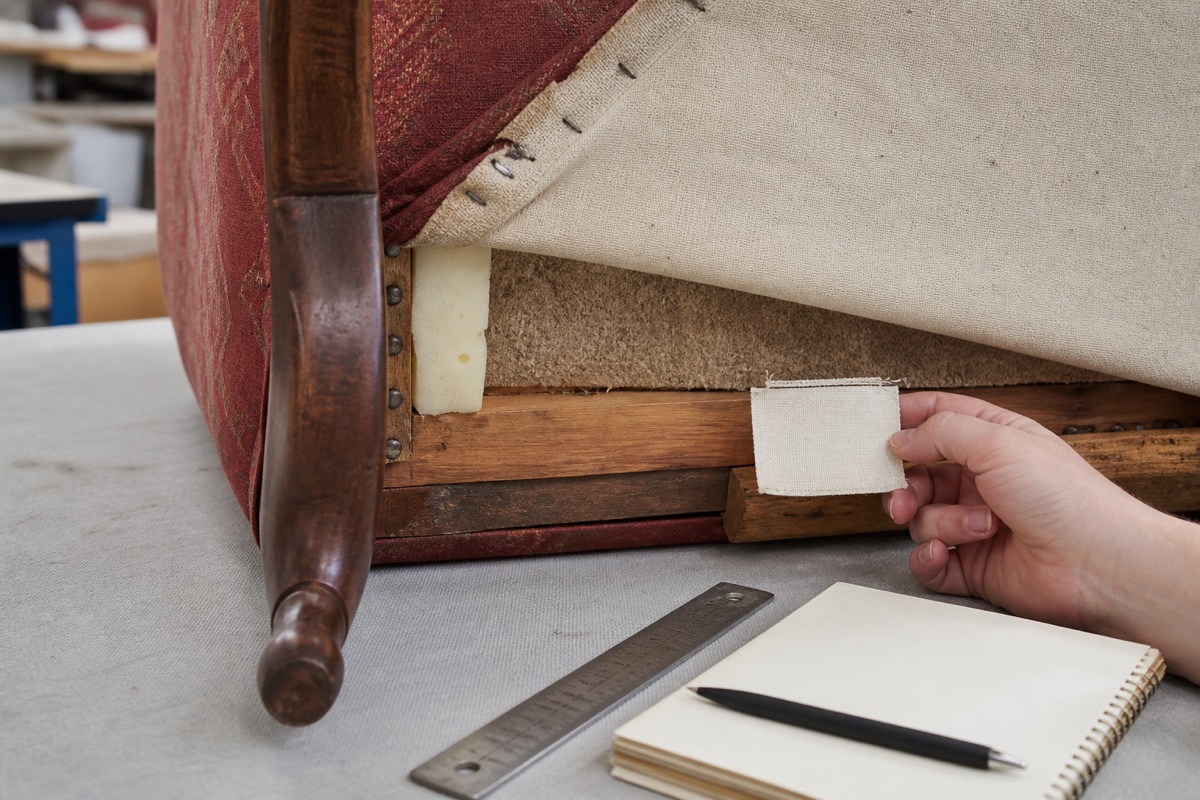
Photograph the whole object, permanent labels, underside, cover, filling sequence and any supplier markings before removing tacks or fabric. Preserve labels with the item and copy them into the project file. Record whether material is being cleaned, locally repaired, fully re-covered or supplied to another person. A cosmetic surface job and replacement of cover or filling do not create the same evidence needs.
The reupholstery scope guide maps panels, filling, structure and access. Add a separate compliance field rather than burying it in the craft notes. If a label is absent, damaged or inconsistent with construction, do not invent a replacement or assume the item passes. Escalate the documentation gap to an appropriate professional.
Ask a compliance professional a complete question
Provide product type, age if known, intended market, domestic or non-domestic setting, supply action, material changes and surviving labels. Ask which legislation and standards apply now, what testing or supplier evidence is needed, what records must remain with the item and whether the proposed repair changes its status. A clear fact pattern is more useful than asking whether "leather furniture is fire safe."
Pause work when filling identity is unknown, labels conflict, the item will be resold or placed in a public setting, or the project changes several upholstery layers. Keep links to the official source and the date checked. Regulatory literacy is not memorizing one label image; it is knowing which authority, version and evidence govern the actual supply decision.
Source note: GOV.UK upholstery guidance. Accessed August 25, 2026.