Glossary • Guides & News
Which leather terms should a buyer understand first?
Leather terms help a buyer ask better questions, but each term needs the finish and application around it.
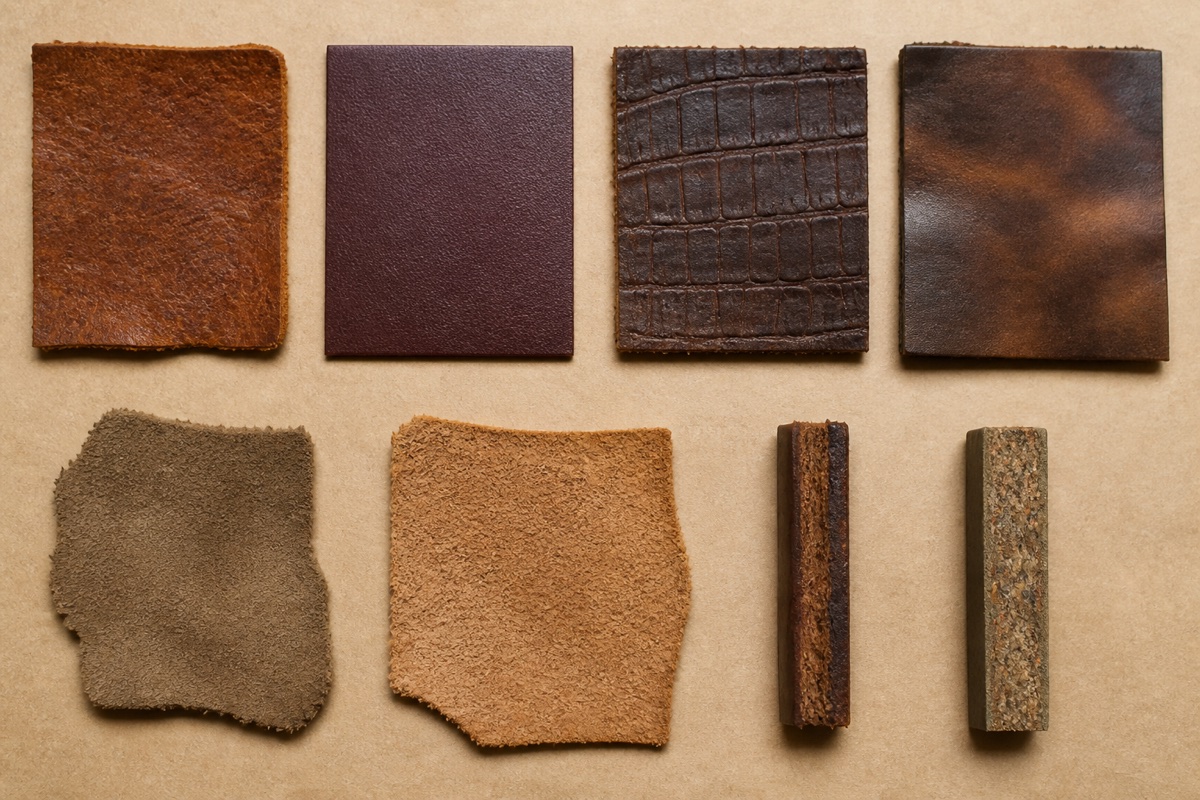
Aniline, corrected grain, nubuck, pigmented, pull-up and bonded describe different material or finish ideas. They are not a single ladder from bad to good.
Use the glossary beside a product specification and ask what the surface will face.
The diagnostic atlas then turns vocabulary into an action question.
Terms about the visible surface
The same behaviour shows up in another setting, described in working notes.
Aniline leather has minimal opaque surface finish, so natural grain remains visible and everyday marks can enter the appearance more readily. Semi-aniline leather carries a light protective finish, often with some pigment, while keeping much natural character. Pigmented leather uses a more substantial color coating for protection and uniformity. These labels describe a finish relationship, not a complete ranking of price, craft or suitability.
Corrected grain means the grain surface has been altered, commonly through buffing and finishing, to create a more uniform result. Embossed leather carries a pattern pressed into the surface. A printed grain can look convincing, so pores and visual texture alone do not confirm construction. Use specification, accessible edges, finish response and intended application together.
Terms about hide layers and nap
Full grain uses the grain surface without sanding away that top structure. Top grain is a broader upper-layer term and can include a corrected surface in commercial usage. Split leather comes from the lower layer after thickness is divided. Those terms say which portion of the hide is involved, but finish, thickness, backing and workmanship still shape performance. Read the grain-layer guide before turning one word into a quality verdict.
Nubuck presents a finely buffed grain surface with a raised velvet-like nap. Suede commonly presents the flesh side or a split and often has longer visible fibers. Directional shading is normal on both because fibers reflect light differently as they move. Smooth-leather cream can mat that nap, so identification immediately changes the care conversation.
Terms about composites, coatings and effects
Bonded leather is made from leather fibers or pieces held together with a binding substance; it is not the same construction as a continuous hide layer. Coated split uses split leather beneath a coating. Coated vinyl uses a different, synthetic substrate even when its printed texture resembles leather. Ask sellers to name the substrate and surface system rather than relying on leather-look language.
Pull-up leather contains oils or waxes that shift when the material is bent, producing a lighter pulled area that can return as the surface relaxes. Patina is the change developed through age, handling and environment; it is not a synonym for dirt or every form of damage. Finish is the treatment that establishes surface appearance and protection, which may include transparent or pigmented layers.
Use vocabulary to improve the next question
A product listing that says full-grain leather still leaves useful questions: is it aniline or pigmented, how thick is it, what backing and construction are used, and what care does the maker specify? A sofa described as suede still needs confirmation that the surface is true suede rather than microfiber or another napped material. Vocabulary narrows uncertainty; it does not remove the need for evidence.
Bring the confirmed terms into the Diagnostic Atlas with application, visible problem and prior treatments. "Pigmented automotive leather with finish abrasion on the entry bolster" is more actionable than "dry leather." "Nubuck with compressed nap and an oil edge" prevents a smooth-leather cleaner from entering by mistake. Good terminology is practical because it changes what not to do.
Source note: Leather Naturally. Accessed August 25, 2026.